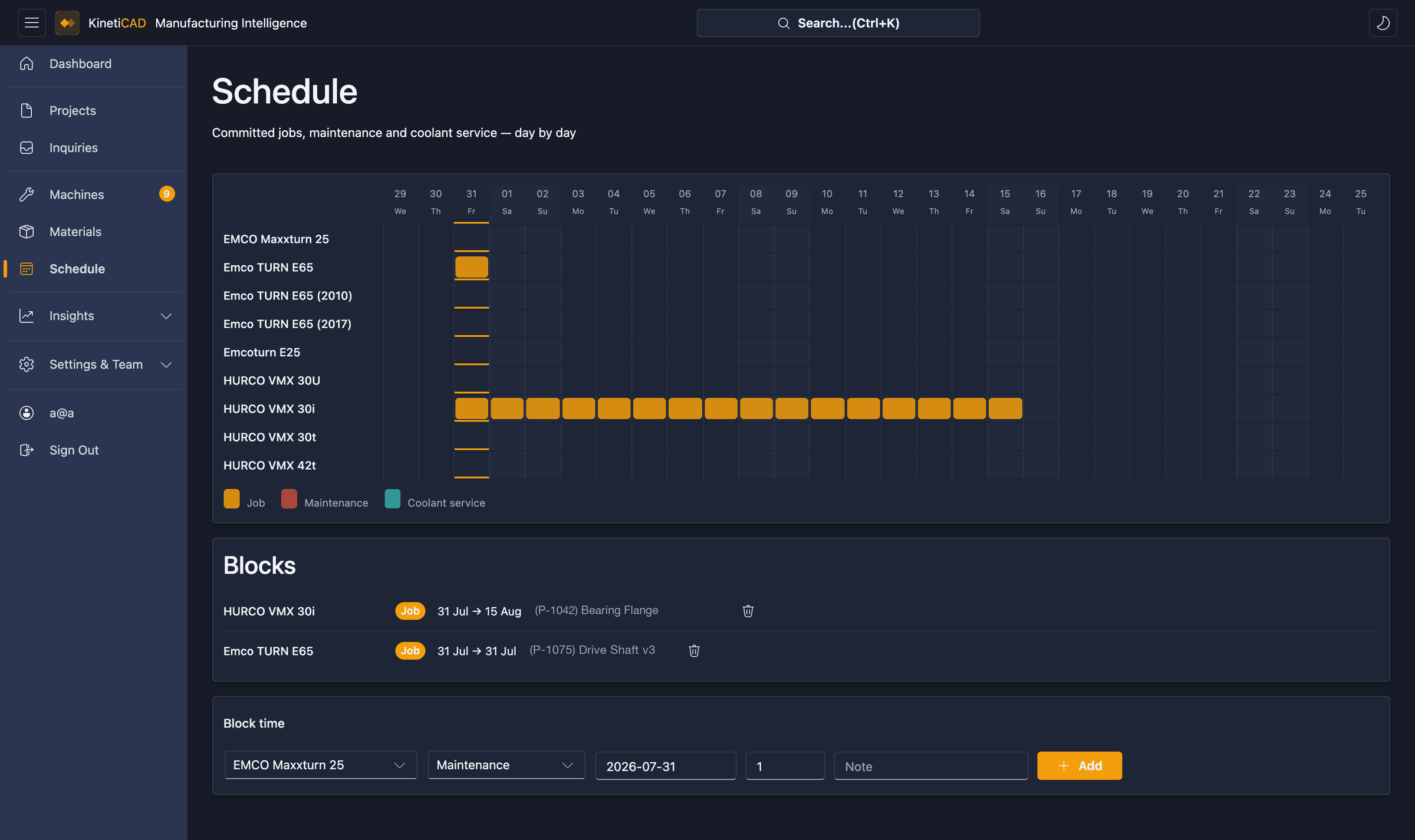
Three steps. Your team stays in charge of the last one.
A CAD model, a technical drawing and a quantity - the same things your customers already e-mail you. No re-modelling, no CAM seat.
STEP model · PDF drawingFeatures are recognised, operations sequenced across your machines and tool magazines, and NC code generated and simulated against the model.
Milling · Turning · Multi-machineCheck what came out and release it. If an operation is not how you would run it, change it in the 3D workspace and the NC rebuilds around it. Today, that is where your team takes over.
Operator approval always requiredThe STEP model is parsed into geometry (faces, edges, holes, pockets, turned profiles) while the PDF drawing is read for the tolerances, finishes and notes that never make it into the 3D file.
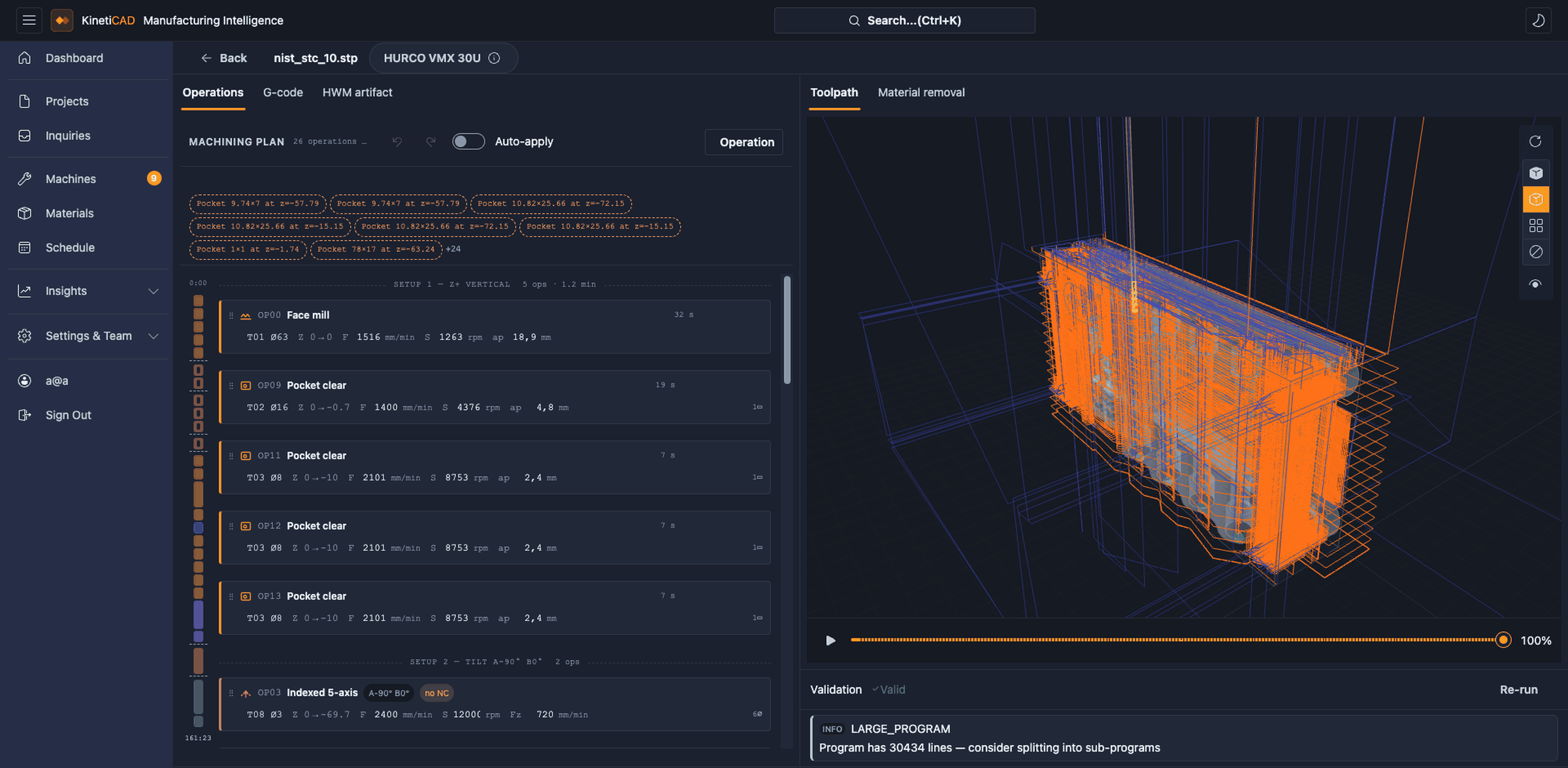
Machinable features are identified and labelled, and the views the system needs to be confident about them are rendered and checked, so nothing on the part is missed.
Operations, tools, strategies and cutting parameters are chosen against the machines, controls and tool magazines the shop actually has - including routing a part across a lathe and a mill.
Strategy generators emit the G-code and an assembler stitches it into the final program. No language model touches the NC path - a wrong block can destroy a workpiece, a tool or a spindle, so that part stays deterministic on purpose. Every program is then cut in a material-removal simulation and compared against the CAD model: material left behind and material taken wrongly are both measured, and if either exceeds threshold the program is not released.
Today the platform automates everything up to the machine: the plan, the programs, the price and the slot. What it does not do yet is move the part. That is the half we are building next - a robot that loads the machine, takes the part out when the operation finishes, and hands it to the next machine on the route until the part is done.
Loading and unloading planned alongside the machines they serve, and the transfer between them, so a job covers the whole route rather than stopping at each spindle.
Extending planning and program generation beyond milling and turning into sheet processing.
Quotes, jobs and capacity flowing straight into the systems a shop already runs on.
Enough verification and scheduling confidence to run the chain unattended, and put the finished part away without anyone on the floor.